

The property and casualty (P&C) insurance industry is entering a new phase of AI adoption. Traditional automation handled repetitive tasks, while generative AI helped create summaries, emails, and insights. Agentic AI goes a step further—it can understand a business goal, plan a sequence of actions, execute tasks across systems, and continuously improve outcomes.
Guidewire has positioned Agentic AI as a key capability within its cloud ecosystem, enabling insurers to automate complex workflows such as claims handling, underwriting support, policy servicing, and customer engagement.
🔗 Explore our Guidewire Services
For insurance executives, CIOs, COOs, claims leaders, and digital transformation teams, understanding how Guidewire Agentic AI works is essential for making informed investment decisions in 2026.
1. What Is Guidewire Agentic AI?
Guidewire Software Agentic AI is an AI-driven orchestration layer that combines Guidewire Cloud, Guidewire Data Platform, AI models, workflow automation, and business rules to perform insurance tasks with minimal human intervention.
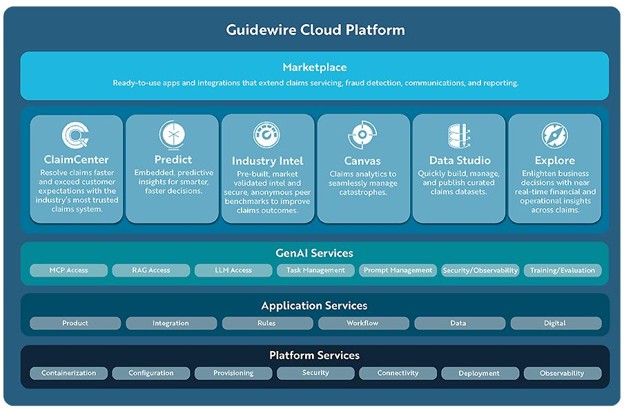
Unlike a basic chatbot, an AI agent can:
- Understand an insurance objective (e.g., “resolve this auto claim”)
- Gather data from PolicyCenter, ClaimCenter, BillingCenter, and external sources
- Analyze documents, images, and historical claim patterns
- Recommend or execute actions based on business rules
- Escalate exceptions to human adjusters or underwriters
- Learn from feedback and operational outcomes
This creates a human-in-the-loop automation model, where AI handles high-volume operational work while insurance professionals focus on judgment, compliance, and customer relationships.
Accelerate Guidewire innovation using intelligent AI solutions. Talk to our Expert today
2. How Guidewire Agentic AI Works Inside Insurance Operations
The workflow can be understood in five connected stages.
- Intelligent Intake
The agent receives information from multiple channels:
- FNOL (First Notice of Loss)
- Customer portals
- Agent portals
- Email and chat
- Mobile apps
- IoT or telematics feeds
- Contextual Reasoning
The AI analyzes:
- Policy coverage
- Deductibles
- Prior claims
- Fraud indicators
- Repair estimates
- Customer history
- Regulatory requirements
- Workflow Orchestration
The agent determines the next best actions, such as:
- Assigning a claim
- Requesting additional documents
- Triggering a fraud review
- Scheduling an inspection
- Generating settlement recommendations
- System Execution
Through Guidewire APIs and cloud integrations, the agent can update records, create tasks, send notifications, and initiate payments.
- Continuous Monitoring
The system tracks outcomes, SLA performance, leakage, customer satisfaction, and operational efficiency to refine future decisions.
This is why Agentic AI is often described as AI that acts, not just AI that answers.
3. Why Insurance Leaders Are Investing in Agentic AI
P&C insurers are facing simultaneous pressures:
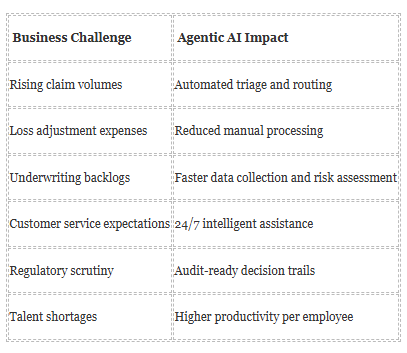
Claims Transformation Example
A traditional claim may require:
- FNOL intake
- Coverage verification
- Document collection
- Adjuster assignment
- Repair coordination
- Settlement calculation
- Customer updates
An Agentic AI workflow can complete many of these steps automatically within minutes, significantly reducing cycle time and improving customer experience.
4. Guidewire Agentic AI Use Cases That Deliver Measurable Value
Claims Automation
- Auto claim triage
- Photo-based damage assessment
- Medical document summarization
- Fraud scoring
- Settlement recommendation support
Underwriting Assistance
- Submission intake
- Risk data enrichment
- Appetite matching
- Quote preparation
- Underwriter workbench prioritization
Policy Servicing
- Endorsement processing
- Coverage explanation
- Renewal outreach
- Agent support automation
Billing and Collections
- Payment reminder optimization
- Delinquency prediction
- Self-service payment assistance
Catastrophe Response
During CAT events, AI agents can rapidly classify claims, prioritize severe losses, and coordinate large-scale communication with policyholders.
These use cases are particularly valuable for insurers running Guidewire PolicyCenter, ClaimCenter, BillingCenter, InsuranceNow, and Guidewire Cloud.
5. How FECUND Software Services Helps Insurers Adopt Guidewire AI Successfully
Implementing Agentic AI is not just a technology project—it requires deep expertise in Guidewire architecture, insurance workflows, integration engineering, data quality, testing, and cloud operations.
FECUND Software Services specializes in Guidewire services for P&C insurers across implementation, integration, upgrades, QA, and managed support.
FECUND’s AI-Ready Guidewire Capabilities
- Guidewire Cloud Implementation: Configure InsuranceSuite to support AI-driven workflows.
- API & Integration Services: Connect Guidewire with AI platforms, document systems, telematics, and third-party data providers.
- Data Migration & Quality Engineering: Ensure clean, structured data for reliable AI outcomes.
- Guidewire Testing & QA: Validate AI-assisted business processes, regression scenarios, and compliance requirements.
- Managed Guidewire Support: Continuously optimize performance, workflows, and cloud operations after go-live.
6. Why Insurers Choose FECUND
With expertise across Guidewire PolicyCenter, BillingCenter, ClaimCenter, Integration, Cloud, QA, and Digital Portals, FECUND helps insurers move from pilot AI initiatives to production-scale operational automation.
For insurers evaluating Agentic AI, the fastest path is often:
Assess → Integrate → Test → Govern → Scale
FECUND supports each stage of that journey.
The Strategic Takeaway for 2026 Insurance Executives
Agentic AI is not replacing insurance professionals; it is redefining how insurance work gets done.
The most successful insurers in 2026 are building:
- Cloud-native Guidewire ecosystems
- API-first architectures
- Trusted insurance data platforms
- AI governance frameworks
- Human-in-the-loop operational models
Guidewire provides the platform foundation, while experienced implementation partners such as FECUND Software Services help insurers translate AI potential into measurable business outcomes—faster claims, lower operational costs, improved underwriting productivity, and better policyholder experiences.
As competition intensifies across the P&C market, the question is no longer “Should we use AI?” but “How quickly can we operationalize Agentic AI within our Guidewire ecosystem?”
Frequently Asked Questions (FAQ)
1. What is Guidewire Agentic AI?
Guidewire Agentic AI is an AI-driven orchestration capability that can understand insurance objectives, gather data, execute workflows across Guidewire systems, and collaborate with human users to complete complex insurance tasks.
2. How is Agentic AI different from generative AI?
Generative AI primarily creates content such as summaries, emails, or responses. Agentic AI can plan actions, interact with enterprise systems, execute workflows, and make context-aware operational decisions.
3. Which Guidewire products can benefit from Agentic AI?
Guidewire PolicyCenter, ClaimCenter, BillingCenter, InsuranceNow, Guidewire Cloud, and the Guidewire Data Platform can all support AI-driven automation and workflow orchestration.
4. How can FECUND Software Services help with Guidewire AI adoption?
FECUND provides Guidewire implementation, integration, cloud migration, testing, data engineering, and managed support services that enable insurers to deploy AI-ready Guidewire environments and scale Agentic AI initiatives securely and efficiently.
Scale Guidewire Cloud with trusted AI expertise. Connect with FECUND Guidewire AI experts today


